Stellar Phase III: Institutional Access on BiFu
Bifu Editorial · 2026-10-13 · 5 min read
Table of contents
BiFu and Trivesta Group bring selected investment interests previously held by an institution to eligible platform users. Stellar Phase III starts at 100 USDT, with a one-month closed holding period linked to the underlying assets' planned unlock and exit.
Investment interests acquired early by an institution can offer another entry point as their lock-up period approaches its final stage.
BiFu and international investment management group Trivesta Group have introduced the Stellar Institutional Allocation Program (Phase III). Through a targeted transfer of selected interests, eligible platform users can participate in the assets' later unlock and exit without going through the institution's full earlier holding period.
Subscriptions start at 100 USDT, with a 1,000,000 USDT allocation and a one-month product term. Stellar Phase III is open for subscriptions on BiFu, bringing these previously held institutional interests into a closed holding arrangement.
BiFu and Trivesta Group Open a Route to Institutional Interests
According to the product information, Trivesta Group was founded in 2004 and is headquartered in Australia. It focuses on alternative asset management and multi-strategy investment, with more than twenty years of market experience and a business presence across markets including Australia, Singapore and Hong Kong. Its investment activities cover traditional financial markets and digital assets.
Through the partnership, Trivesta Group is making selected assets available for allocation through BiFu. Interests originally directed mainly at institutional investors can now be offered to eligible users through the platform's product interface.
The institution's background provides context on the asset source and management experience. Investment results still depend on this phase's assets and their actual exit.
Join at a Later Stage of the Assets' Lock-Up Period
The underlying assets of Stellar Phase III originate from cornerstone investment interests that Trivesta Group acquired through earlier participation in projects. The selected asset batches have entered the later stage of their lock-up period. The program takes over relevant interests through a negotiated transfer, with its holding and exit arrangements linked to the assets' unlock schedule.
Participants do not need to repeat the holding period the institution has already completed. They join this phase's one-month closed holding arrangement, after which the program arranges asset exits and settlement according to market conditions.
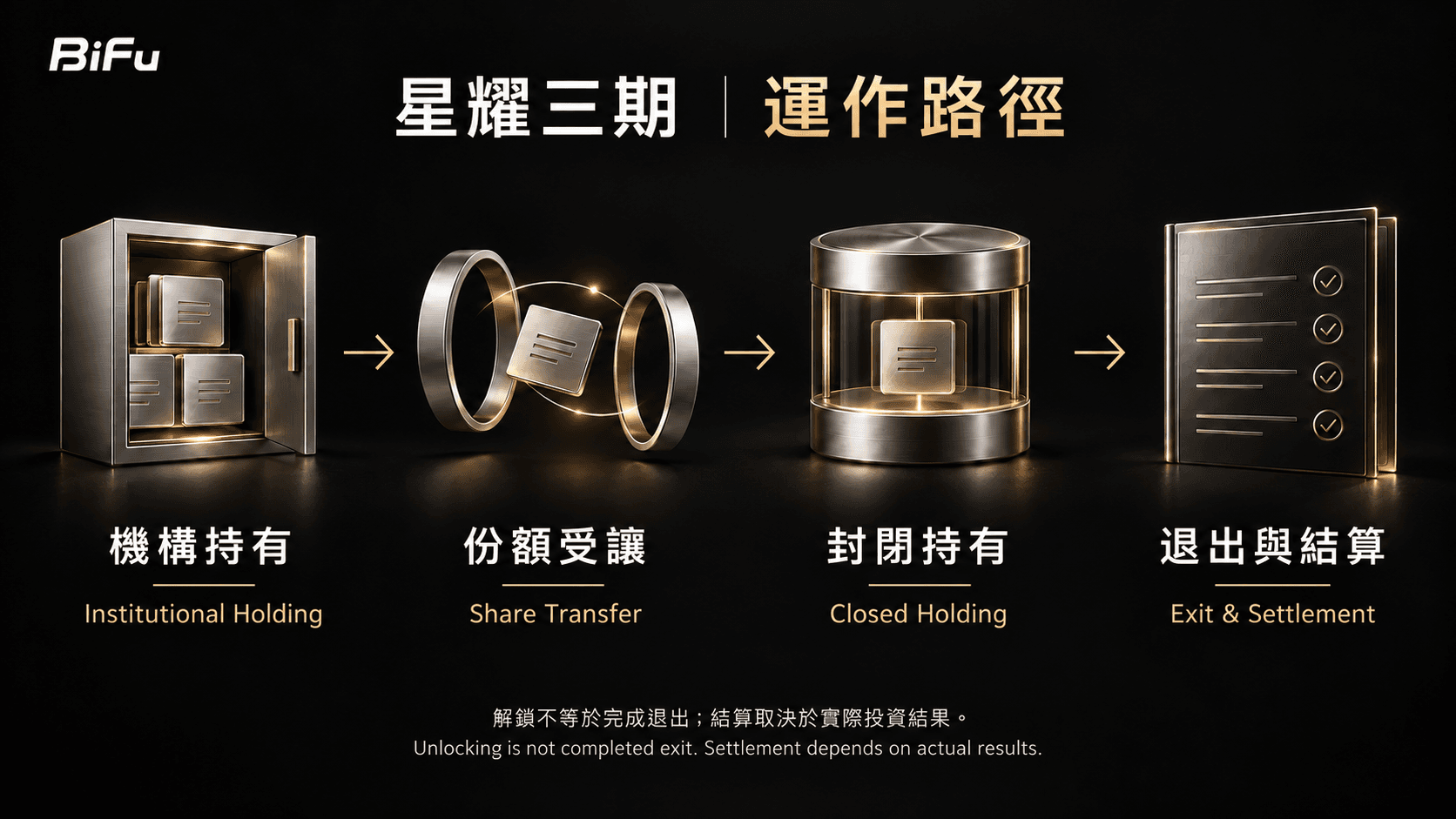
Unlocking is only one condition for an exit. It does not mean the assets have been sold or that funds will be returned on schedule. Users hold investment interests under the program, with their specific rights defined by the formal documents. This does not mean they directly own and can independently trade shares in the underlying companies.
The Same Market Price, Different Acquisition Costs
The program's return mechanism is based on the difference between acquisition cost and the eventual exit price. Through the partnership, it seeks to acquire relevant interests at a negotiated price close to the institution's holding cost, creating a potential cost advantage.
Consider a hypothetical example: an asset has a reference purchase price of USD 10 in the public market and an assumed negotiated transfer price of USD 8. If its market price reaches USD 12, the two acquisition costs produce different unrealized gains before fees:
| Hypothetical Acquisition Route | Acquisition Price | Market Price | Unrealized Gain Before Fees |
|---|---|---|---|
| Purchase at the market reference price | USD 10 | USD 12 | 20% |
| Acquire at the negotiated transfer price | USD 8 | USD 12 | 50% |
The difference comes from acquisition cost. This example shows a single asset's unrealized gain at assumed prices. It does not establish the actual transfer discount for this phase or the product's one-month return. The final outcome depends on the actual exit price and applicable fees. An exit value below cost would still produce a loss.
Earlier Results: Actual and Estimated
According to the program's product materials, Phase I recorded an actual one-month absolute return of 45.01%, not annualized. Phase II materials list an estimated one-month absolute return of 31.27%, not annualized, subject to the final settlement and distribution results.
The distribution record for Phase I is available in the Phase I review. These figures provide background on earlier phases. Phase III has its own asset batches and exit conditions; historical performance cannot be used to project this phase's return.
Stellar Phase III Starts at 100 USDT
The main parameters for this phase are:
| Item | Arrangement and Limitations |
|---|---|
| Allocation size | 1,000,000 USDT; the total quota may be adjusted |
| Subscription minimum | 100 USDT per subscription |
| Cumulative subscription limit per account | 10,000 USDT, subject to the final applicable terms |
| Product term | One month of closed holding; no early redemption or transfer during this period |
| Holding-period return target | 10%–30% absolute return over one month; not annualized and not guaranteed |
| Subscription deadline | Product materials and the public page list October 18, 2026; the actual cutoff is subject to the current announcement |
The return target is a reference estimate based on historical market performance and relevant data. It is not fixed interest, and neither principal nor returns are guaranteed. Actual results depend on asset exits, applicable fees and settlement arrangements.
Under the product materials' described process, users submit subscription applications through BiFu. Allocation takes place after the subscription period closes, with priority for whitelisted users and unallocated funds returned. Following the closed holding period, settlement is made to BiFu accounts according to actual investment results. An application does not guarantee a full allocation, and maturity does not guarantee immediate receipt of funds.
Explore the Current Allocation on BiFu
Stellar Phase III involves equity assets in traditional financial markets. Falling market prices, valuation declines or insufficient liquidity may affect exit prices, cause a loss of principal or delay settlement. Funds cannot be withdrawn early during the closed period.
Visit the Stellar Phase III product page on BiFu for allocation and subscription details, or explore other product information through BiFu RWA. Participation is subject to applicable regional, account and product eligibility requirements.
Explore Stellar Phase III
BiFu and Trivesta Group bring selected investment interests previously held by an institution to eligible platform users. Stellar Phase III starts at 100 USDT, with a one-month closed holding period linked to the underlying assets' planned unlock and exit.
Disclaimer
This content is for educational purposes only and does not constitute financial, investment, legal, tax or trading advice. Digital assets, RWA products, gold-related products and forex products involve risk, including possible loss of principal. Always review product rules and risk disclosures before trading.
Related articles
Tokenized Funds vs Traditional Funds Comparison
Traditional and tokenized funds share assets, managers, and NAV, but tokenization changes ownership, transfer, and settlement. Blockchain tokens offer faster, fractional access and efficiency, yet market, liquidity, and smart-contract risks remain.
2026-10-13 · 6 min read
Tokenized Dollar Liquidity Products Explained (Including FUIDL)
Tokenized USD liquidity products combine money-market exposure with on-chain settlement. FUIDL, listed on BiFu for eligible investors, offers AAA-rated money-market exposure, hourly-scale processing, multi-chain issuance, and RWA access, but risks remain.
2026-10-13 · 5 min read


Trading
Risk Warning
Trading foreign exchange, contracts for difference, over-the-counter derivatives, margin products, and other leveraged financial instruments involves a high level of risk and may not be suitable for all clients. These products can result in losses that may exceed your initial deposit, depending on the product terms, account settings, and applicable legal protections. You should not trade unless you fully understand the nature of the products, the risks involved, and the extent of your exposure. When trading derivative products, you do not own or have any rights to the underlying asset.
The information provided on this website is general in nature and does not take into account your investment objectives, financial situation, trading experience, or particular needs. Nothing on this website should be construed as personal financial advice, investment advice, an offer, invitation, solicitation, recommendation, or inducement to buy, sell, subscribe for, or dispose of any financial product or service.
All market commentary, educational materials, research content, platform information, and other materials published on this website are provided for general information and reference purposes only. Past performance, historical data, examples, forecasts, or simulated results are not reliable indicators of future performance.
Access to Bifu Markets’ products and services is not available in all jurisdictions. We do not open accounts for residents of certain countries and jurisdictions, including but not limited to the United States, Australia, Canada, and the Democratic People's Republic of Korea.
By accessing this website, you confirm that you are doing so on your own initiative and that you are responsible for ensuring that your use of this website and any services provided by Bifu Markets complies with the laws and regulations applicable to you in your jurisdiction.
Bifu is operated by Bifu Markets (Pty) Ltd.
Registered address: Norwich Place West, 2nd Floor, Cnr 5th and Norwich, Sandown, Sandton, Gauteng, South Africa.